
UK PSC Ownership Chains: What the Register Shows and What It Doesn't
The UK's register of People with Significant Control was introduced in April 2016. According to GOV.UK summary guidance, its purpose is to increase transparency over who owns and controls UK companies, inform investors, and support law enforcement in money laundering investigations.
The register is public, free to access, and sourced from mandatory filings. It is not a linked ownership graph. Each company's entry shows one link in the chain. This article explains why, what the legislation requires, and how DataLedger resolves the full chain programmatically.
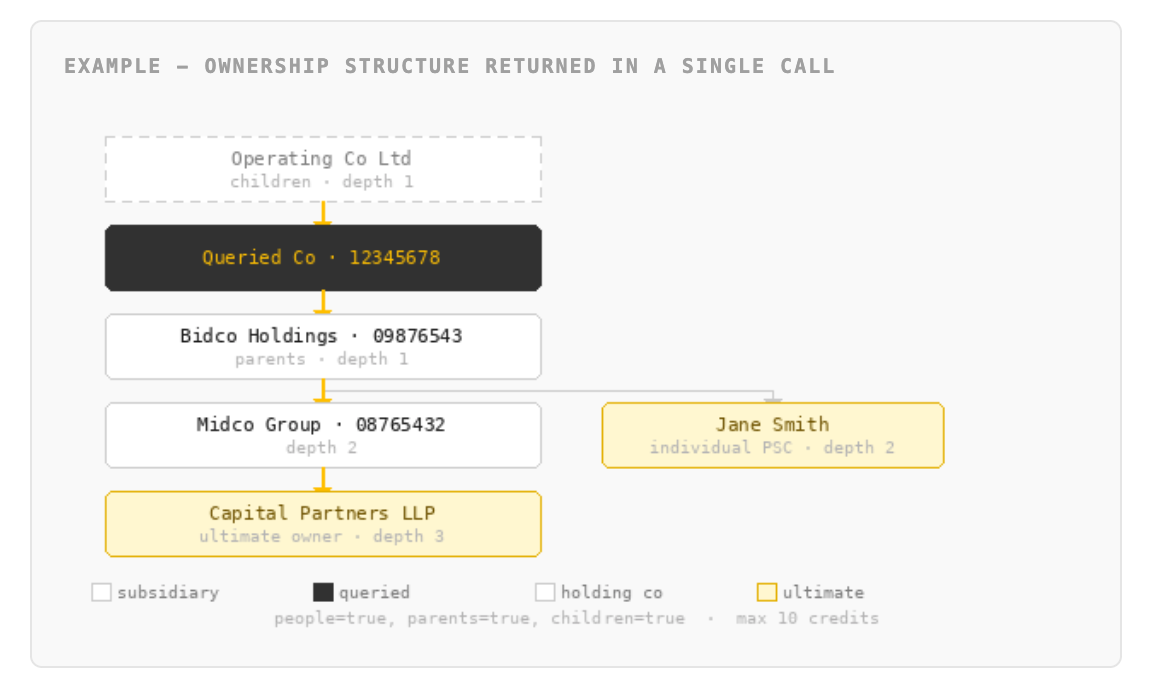
Ownership chain visualisation
What Companies Are Required to File
The PSC regime is governed by Part 21A of the Companies Act 2006, inserted by Schedule 3 of the Small Business, Enterprise and Employment Act 2015 and amended by the Economic Crime and Corporate Transparency Act 2023. The current authoritative guidance is Version 5, published by the Department for Business and Trade on 18 November 2025.
A company must register anyone who meets one or more of the five specified conditions:
Holds more than 25% of shares
Holds more than 25% of voting rights
Holds the right to appoint or remove a majority of the board
Otherwise exercises significant influence or control
Exercises significant influence or control over a trust or firm that itself satisfies one of the above
Where the controlling interest is held by another company rather than an individual, only the first company directly above in the ownership chain is registered. Not every entity above it, and not the ultimate individual. The DBT full guidance (Chapter 2.2) states this explicitly: a company "is not required to look further at its chain of ownership for any indirect interests" held through that first entity.
The law assumes that anyone tracing ownership will follow the chain upward, register by register. Across millions of companies, that manual traversal is the problem.
The Overseas Limit
A company in the ownership chain only qualifies for registration if it is subject to UK disclosure requirements. In practice, this means it must be a UK-registered company with its own PSC obligations, or an entity listed on an approved regulated market. This is set out in section 790C(6)-(7) of the Companies Act 2006.
An unlisted overseas holding company (a BVI entity, a Jersey vehicle, a Cayman structure) does not qualify. Where such an entity appears in the chain, UK law requires companies to look through it to find the next qualifying entity or the underlying individual. Where no qualifying entity exists and the ultimate individual is not disclosable under UK law, the chain ends there.
This is a statutory limit, not a data gap. It is why the PSC register records controlling persons under UK law rather than functioning as a universal ultimate beneficial ownership register. For chains made up entirely of UK-registered companies, all the data exists in the register. The challenge is connecting it.
DataLedger PSC API: Resolved Ownership Chains
The DataLedger PSC API traverses the full Companies House PSC dataset and resolves the complete ownership chain for any given company number. It works upward through every intermediate UK-registered entity to the ultimate UK parent or named individual.
A three-tier structure (OpCo owned by HoldCo owned by TopCo owned by an individual) requires three separate Companies House lookups in the raw data. The DataLedger API returns all four entities and the individual in a single call.
The API returns:
The full parent chain from the target company to the ultimate UK parent or controlling individual
All child companies (UK-registered subsidiaries) beneath any entity
Each entity's Companies House registration number and nature of control
A flag where the chain reaches an overseas entity, showing where the UK-disclosed chain ends
Individual PSC data at chain termination: name, year of birth, nationality, and nature of control
Structured financial data for the searched company, where accounts have been filed electronically with Companies House
Where the chain ends at an overseas entity, that entity is returned and flagged. Nothing beyond what the UK register contains is inferred or added. All data is sourced directly from Companies House electronic filings.
Further Reading
Register of People with Significant Control - Full Guidance, Version 5 - Department for Business and Trade, 18 November 2025
Summary Guidance for Companies - GOV.UK, 19 November 2025
2026 Statutory Guidance on Significant Influence or Control - GOV.UK
The DataLedger PSC API is available now. Sign up for 25 free credits at dataledger.uk. Full endpoint reference and example responses are in the developer docs.
